Wednesday, September 28, 2011

Boer buck tops sale

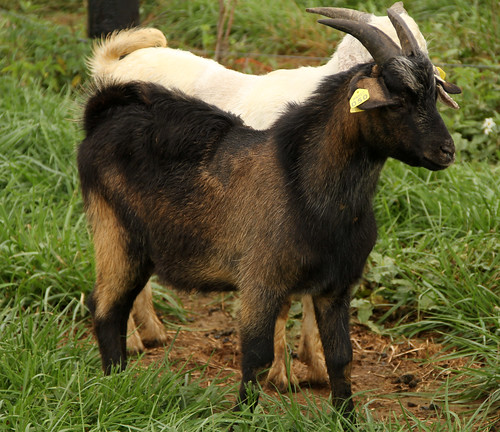
A Full Blood Boer buck consigned by Sherrie Losch (PA) was the high-selling buck at the 2011 Western Maryland Goat Field Day & Sale held on September 24 near Boonsboro, MD.  The 11 bucks that met the 2011 Gold, Silver, or Bronze standards of performance were offered for sale via silent auction.

The Losch buck met the Gold standards of performance for parasite resistance and parasite resilience. It sold for $875. The buyer was Lynda Heise from St. Thomas, PA.  Losch's Boer bucks have usually posted good fecal egg count data.
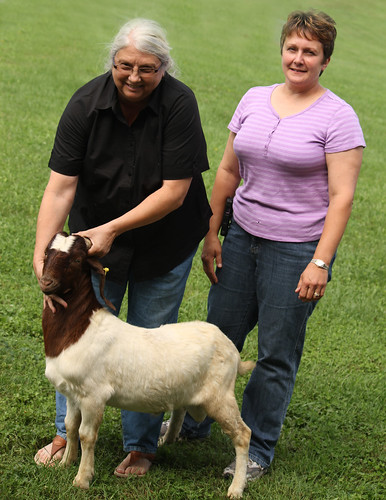
High-selling Boer buck
(L-R) Lynda Heise and Sherrie Losch

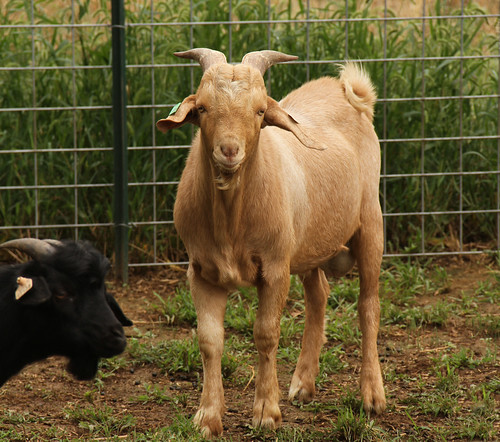
The next high-selling buck was a Purebred Kiko consigned by P.J. Murphy (NJ). It sold for $725.  It was also purchased by Lynda Heise. Murphy is a first year consigner and previous buyer of top-performing bucks.

Merritt "Sam" Burke (DE) was the top consigner in this year's test.  He sold all four of his bucks that qualified for the sale.  His top selling buck brought $450.  It sold to Mike & Rachel Moran from Alderson, WV.  Burke was also recognized for being a five year consigner to the test.

The top-gaining buck was a Savanna x Spanish buck consigned by Janet & Stephen Garrett (VA). The crossbred buck sold for $350. The buyer was Zach Teter from Beverly, WV. The Garretts are first year consigners.

2011 Top consigner and 5 year consigner 
(L-R) Lawrence Burke and Sam Burke

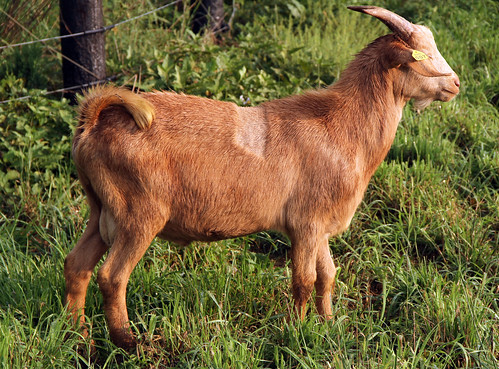
The top-performing buck in this year's test was a Kiko x Boer buck consigned by Luke Miller from Indiana. This was the only buck that met the Gold standards of performance.  Miller also had a buck that met the Silver standards of performance.

Both of Miller's top-performing crossbred bucks are going back to his Indiana farm for breeding. Miller is a first year consigner to the test and a previous buyer of top-performing bucks.

In addition to the bucks sold in the sale, Lincoln University (Missouri) purchased four bucks from the test via private treaty. For their upcoming research project, they required two parasite "resistant" and two parasite "susceptible" registrable Kiko bucks.

The four Kiko bucks selected by Lincoln will be used in a divergent selection experiment on parasite resistant. It will be interesting to follow the progress of this research. Of particular interest will be the fecal egg counts of the offspring sired by the two resistant and two susceptible bucks from the test.
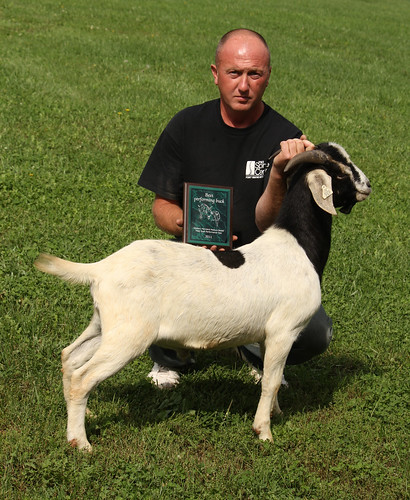
Top-performing Gold buck
Consigned by Luke Miller

Lincoln purchased the most resistant buck in the test, a Purebred Kiko consigned by Craig Adams (IL).  The Adams buck never had a fecal egg count above 500 epg. Its average egg count was 131 epg. The Adams buck was also one of the most resilient bucks in this year's test.  All of his FAMACHA© scores were 1.

Jeanne Dietz-Band (MD) also had a buck whose FAMACHA© scores were all 1. The other "resistant" buck purchased by Lincoln University was a Purebred Kiko buck consigned by Mike & Lori Renick (WV).

Seven does were offered for sale via private treaty. The high-selling doe was a Kiko yearling doe consigned by P.J. Murphy.  It sold for $600. Mark Sweitzer's four Kiko doe kids brought an average of $225 each.
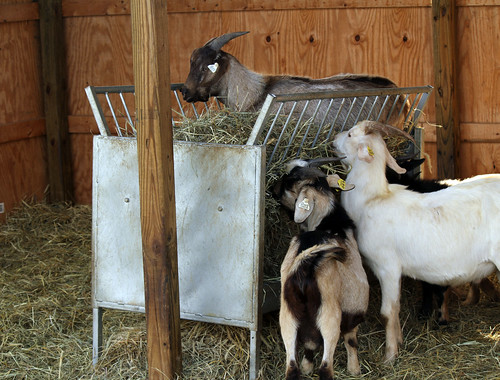
Goats in the feed pen are scheduled for harvest on 9/29

Thanks is extended to everyone who was involved with the 2011 test, sale, and field day:  university faculty and staff, consigners, buyers, bidders, speaker, veterinarians, vendors, and volunteers.

Thursday, September 22, 2011

Final test results

Eighty (80) bucks were delivered to the test site on Friday and Saturday, June 3 and 4.  On these days, weights ranged from 29 to 69 lbs. and averaged 41.0 lbs.  After a 6-day adjustment period, the goats were re-weighed.  The weights recorded on June 10 were the starting weights for the test. Starting weights ranged from 28 to 70 lbs. and averaged 42.5 lbs.

Final weights were recorded on September 15. Final weights ranged from 37 to 71 lbs. and averaged 54.9 lbs.  While on test, weight gain ranged from -9 to +23 lbs. and averaged 12.4 lbs. Average daily gain (ADG) is determined by dividing the weight gain by the number of days of the test (98). 

The goat with the highest rate-of-gain was a Savanna x Spanish buck consigned by Janet & Stephen Garrett (VA). The #34 buck gained 0.235 lbs. per day.  His ADG ratio was 181%, meaning he gained 81% better than the average buck in the test.  Only bucks with ratios above 100 should be selected for breeding.

Weight gains, while not robust, were steady, as evidenced in the graph below.  During the test period, the goats experienced a variety of weather and forage conditions. The test site was dry during the middle part of the test, but very wet during the last six weeks of the test period.


Download report with weight data 
Download report with ADG rankings


Individual fecal samples were collected every two weeks.  The samples were collected directly from the rectum of the goat, unless the goat provided a sample while he was waiting to be worked.

Fecal egg counts were determined by Dr. Dahlia J. O'Brien's lab at Delaware State University. Fecal egg counts are an estimate of the number of adult worms present in the goat's gut. They are a measure of parasite resistance. 

The purpose of this test is determine which bucks are more resistance to parasites. It goes without saying that bucks which shed a lot of parasite eggs should not be kept for breeding. Parasite resistance is a moderately heritable trait, more so than reproductive traits.

During the early and mid-part of the test, fecal egg counts were not very high. While some goats had high egg counts, the majority of egg counts were below 2,000 epg and often 1,000 epg.  Though clinical parasitism could occur at lower levels, 2,000 epg is often considered the level of clinical significance for the barber pole worm.  Fecal coprocultures showed worm eggs to be almost all barber pole worm (Haemonchus contortus).

During the last six weeks of the test, egg counts rose significantly, as a result of the increased rainfall.  In fact, egg counts from the September 15 collection were so high that they eliminated five bucks from the sale.  Before September 15, these bucks were meeting the standards for parasite resistance.

Three bucks in the test showed themselves to be resistant to the parasite challenge under this year's test conditions. The most "resistant" buck was a purebred Kiko consigned by Craig Adams (IL).  The two other bucks with very low egg count data were a Kiko x Boer buck consigned by Luke Miller (IN) and a Full-blood Boer buck consigned by Sherrie Losch (PA).


Download report with fecal egg count data
Download fecal egg count rankings

A few goats required deworming during the test, but for the most part, clinical parasitism was not a problem during this year's test. The high egg counts from the samples collected on September 15 would likely lead to clinical parasitism if the test were to continue for several more weeks. For this reason, goats with FAMACHA© scores of 3 were dewormed on September 15. Anyone taking home a goat from the test site or sale should continue to monitor the goat for signs of internal parasites.

FAMACHA© scores are an estimate of packed cell volume and the need for deworming individual goats.  While not as heritable as parasite resistance (fecal egg counts), selection for parasite resilience is highly recommended. Goats that require frequent deworming as evidenced by high FAMACHA© scores should not be kept for breeding. Bucks should be held to a higher standard.

Two goats had FAMACHA© scores of 1 each time they were checked, resulting in an average FAMACHA© score of 1.0.  The two most resilient bucks in the test were a purebred Kiko consigned by Craig Adams and a percentage Kiko buck consigned by Jeanne Dietz-Band (MD).


Download FAMACHA© and anthelmintic treatment data
Download FAMACHA© rankings


Please direct questions about the data and test to Susan Schoenian at sschoen@umd.edu or (301) 432-2767 x343.


Monday, September 19, 2011

High fecal egg counts

For the fecal samples collected on September 15, fecal egg counts ranged from 150 to 14,325 epg and averaged 3,050 epg, as compared to 1,437 on September 1.

Seventy-three percent (n=59) of the goats had fecal egg counts above 1,000 epg.  Forty-nine percent (n=39) had fecal egg counts above 2,000 epg. As a precaution (due to increasing egg counts), goats with FAMACHA© scores of 3 were dewormed on September 15 with levamisole (3 ml/50 lbs.).


After being picked up from the test site, producers should continue to monitor the goats for internal parasitism. The increased rainfall during the past six weeks has greatly increased the goats' exposure to infective worm larvae.

Pooled fecal sample
For the pooled fecal sample collected on September 1, the fecal egg count was determined to be 1,008 epg as compared to 400 epg for the pooled sample collected on August 4. Pooled samples are collected randomly from every third goat.

Ninety-four percent of the strongyle eggs were determined to be Haemonchus contortus (barber pole worm).  Two percent were Trichostrongylus and four percent were Oseophagostumum.

Download fecal egg count summary (alphabetical listing)
Download fecal egg count summary (rankings)


Special thanks to Dr. Dahlia O'Brien and her graduate students at Delaware State University for getting the last set of fecals analyzed quickly, so they could be included in the final test results.

Sale line-up changes

As stated in previous blog entries, the final fecal egg count data from the individual samples collected on September 15 still needed to be factored into the test results.

Fecal egg counts have been increasing over the past six weeks and were higher on September 15 than for any other collection day. High egg counts resulted in the disqualification of five bucks that had previously been selected for the sale.

Up until the last fecal collection, these bucks had met Gold, Silver, and/or Bronze standards of performance for parasite resistance.  But, all five had fecal egg counts above 2,000 epg on September 15 which eliminates them from the sale.  One of the Silver bucks was reduced to Bronze due to his egg count.

The next two highest performing bucks were added to the sale line-up.  These bucks gained 0.173 lbs. per day, 40 percent better than the average buck in the test. The two new sale bucks include a Purebred Kiko consigned by Craig Adams (IL) and a purebred Boer consigned by Sherrie Losch (PA).

Adams has had the top-performing buck and top consignment in each of the last two years.  His buck met the Silver standards of performance for parasite resistance (fecal egg counts).  The Losch buck met the Gold standard of performance for parasite resistance.  In fact, Losch's Boer bucks have usually excelled in parasite resistance.

Eleven bucks met  Gold, Silver, or Bronze standards of performance for growth, parasite resistance, and parasite resilience and will be eligible for the sale on September 24.

2011 sale bucks -- data and images

Saturday, September 17, 2011

Fourteen bucks qualify for sale

Fourteen (14) bucks have met Gold, Silver, and/or Bronze standards of performance for growth, parasite resistance and parasite resilience and are eligible for the sale on September 24, 2011.

Two bucks met the Gold standard for all traits.The Gold bucks include a Kiko x Boer buck consigned by Luke Miller (IN) and a 94% Kiko buck consigned by Merritt Burke (DE).  Miller is a first time  consigner, whereas Burke is a Five Year Consigner.

1st year consigner P.J. Murphy has a Kiko buck in the sale.

Four bucks met the Silver standards of performance for all traits.  The Silver bucks include a Purebred Kiko consigned by Mark Sweitzer, two percentage Kikos consigned by Merritt Burke, and a Kiko x Boer buck consigned by Luke Miller.

The Sweitzer buck has the biggest rib eye of any buck in the test (according to ultrasound).  All of the bucks in the Burke consignment qualified for the sale.Two out of Miller's three bucks met the requirements for sale.

Eight bucks met the Bronze standards of performance for all traits. The Bronze bucks include two more Burke consignments, two percentage Kikos consigned by Randy & Loli Allen (TN), and individual bucks consigned by John Smith (VA), Stephen & Janet Garrett (VA), Jarred Dennison (KY), and P.J. Murphy (NJ).

Randy & Loli Allen have two % Kiko bucks in the sale.
Their two bucks in the fed pen also performed extremely well.

Murphy and Garrett are first time consigners. Smith is a Five Year Consigner and had the top-performing buck in 2008. The Garrett buck, a Kiko x Spanish, was the top-gaining buck in the test.

Images and data of the 2011 sale bucks have been posted to the web. Fecal egg count data from the September 15 collection still needs to be factored into the test results.

View images and data of 2011 sale bucks

Friday, September 16, 2011

Private treaty doe sale

A private treaty doe sale will be held in conjunction with the annual Western Maryland Goat Field Day & Sale on September 24, 2011. Seven Kiko does have been consigned to the private treaty sale.

Lot 1 - 84A
Purebred Kiko doe kid
Born March 14, 2011
Born/raised twin
Consigned by Mark Sweitzer, Glen Rock, PA

Lot 2 - 97
Purebred Kiko doe kid
Born March 10, 2011
Born triplet/raised single
Consigned by Mark Sweitzer, Glen Rock, PA

Lot 3 - 54
Purebred Kiko doe kid
Born March 20, 2011
Born/raised a single
Consigned by Mark Sweitzer, Glen Rock, PA

Lot 4 - 94
Purebred Kiko doeling
Born March 12, 2011
Born/raised a twin
Consigned by Mark Sweitzer, Glen Rock, PA

Lot 5 - Gin Z21
New Zealand Kiko yearling doe
Born February 26, 2010
Born/raised twin
Comments:  Yearling doe. Excellent pedigree. Ready to breed.
Consigned by P.J. Murphy, Pittstown, NJ


Lot 6 - Gin Z16
New Zealand Kiko yearling doe
Born February 22, 2010
Born/raised twin
Comments:  Yearling doe. Excellent pedigree. Ready to breed.
Consigned by P.J. Murphy, Pittstown, NJ


Lot 7 - Z19
Purebred Kiko yearling doe
Born February 23, 2010
Born/raised twin
Comments:  Yearling doe. Excellent pedigree. Ready to breed.
Consigned by P.J. Murphy, Pittstown, NJ


Both doe consigners have bucks that have qualified for the sale.

Egg counts continue to increase

For the individual fecal samples collected on September 1, fecal egg counts ranged from 143 to 4,933 eggs per gram and averaged 1437 epg, compared to 887 on August 18 and 338 on August 4.  With the exception of one goat in the pen, no goat had a negative fecal test.

Sixty-four percent (n=50) of the goats had fecal egg counts above 1,000 epg.  Twenty-two percent (n=17) had fecal egg counts above 2,000 epg. These are the highest egg counts that have occurred in this year's test.

September 1 Fecal egg counts (EPG)
Individual bucks are represented on the horizontal axis

As expected, the goats in the feed pen had low fecal egg counts.

The fecal egg count data from yesterday still needs to be incorporated into the test results. The data should be available on Monday, September 19.

Download FEC report

Thursday, September 15, 2011

Final day of data collection

The goats were worked for a final time today by Jeff Semler, David Gordon, Mary Beth Bennett, Jeanne-Dietz Band, Pam Thomas, and Susan Schoenian.  The goats were weighed by Jeff Semler and scored by Susan Schoenian.  Pam Thomas and David Gordon recorded data.

It was the second time in a row that the goats had to be worked in the rain.  The test site has received considerable rain in the past few weeks. The wet weather is likely why the goats did not gain much weight during this final weigh period, as their dry matter intake was probably reduced. The past few weeks of wet weather has also increased the parasite load in the goats, as evidenced by higher FAMACHA© scores and fecal egg counts.

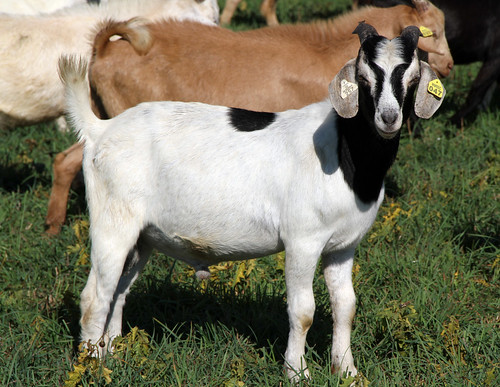
Top-performing buck
Purebred Kiko buck consigned by Mark Sweitzer (PA)

For the last weigh period, gain ranged from -3 to +5 lbs. and averaged slightly less than 1 lb. (0.936).  Average daily gained ranged from -0.214 to + 0.357 lbs. and averaged 0.067 lbs. per day. Three goats gained five lbs. for the period:  two bucks consigned by Kentucky State University and a Boer buck consigned by David & Cindy Thorne (MD).

Smaller bucks often gain better later in the test, perhaps because they are less sexually active.  On the other hand, the rut did not seem to have any effect on performance.  Oftentimes, some of the larger, older bucks lose significant weight during the last two weeks.

FAMACHA© scores ranged from 1 to 4 and averaged almost 2 (1.96), compared to 1.81 on September 1 and 1.56 on August 18. Thirteen goats with FAMACHA© scores of >3 were dewormed with levamsole (Prohibit® sheep drench @ 3 ml/50 lbs.).

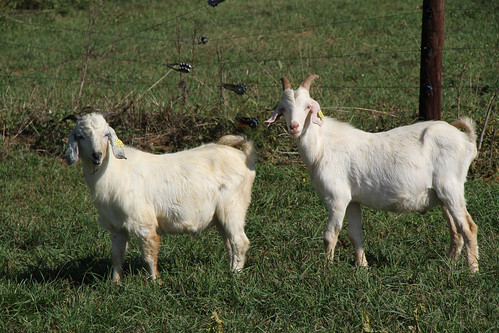
Grazing on September 15

Because all the goats in the pasture test had to stand in the rain and had wet hair coats, coat condition could not easily be evaluated.  Most of the goats had similar body condition scores, as none of the goats in the test are at the more extreme ends of the body condition scale (1-5).  Only a couple of goats showed any signs of scouring and had positive dag scores.  Fecal consistency was good, with few soft stools and no active scouring.

Day-98
For the 98-day duration of the test (June 10-September 15), gain ranged from -9 to +23 lbs. and averaged 12 lbs.  Average daily gain ranged from 0.092 to 0.235 and averaged 0.124 lbs. per day.  Only one goat failed to gain weight during the test period. This buck's weight loss is difficult to explain as the buck has been healthy throughout the test.  Two bucks did not finish the test.  One died and one was removed from the test due to an eye problem.

The data collected today will change the bucks that meet Gold, Silver, and Bronze Standards of performance and qualify for the sale next Saturday.  Some of the bucks that were included in the preliminary group of sale goats will fail to make the sale; others may move up.  Two more fecal egg counts need to be incorporated into the test results.

94-lb. buck in pen
Crossbred Spanish buck from Karen Cooper (KY)

In the pen
The goats in the pen gained 3.3 lbs. during the previous 14-day period, for an average daily gain of 0.238 lbs. per day.  For the 98-day period of the test, average daily gain ranged from 0.01 to 0.357 lbs. per day and averaged 0.232 lbs. per day.

The top-gaining buck in the pen is a 88% Kiko buck consigned by Randy and Loli Allen (TN). It gained 35 lbs. while in the pen.  Two goats that had been doing poorly in the pen did well the past four weeks. While the goats in the pen tended to gained better than those on pasture, two of the penned goats died (cause(s) unknown) before the end of the test period.

Download September 15 (d-98) report

Thursday, September 8, 2011

Preliminary Sale List and Rank

As of September 1, seventeen (17) bucks are meeting the Gold, Silver, or Bronze Standards of Performance for growth, parasite resistance, and parasite resilience. A preliminary sale list and rank has been posted to the web HERE.

Much can still change in the sale list and rank, as some bucks may fail to gain weight during the rut. The wet weather may also have an effect on final weight gains.

The sale list and rank will be updated after September 15 to reflect final weights and scores. The sale list and rank will be updated after September 19 to reflect the last egg count data.

Keep checking the web page for updated information. Pictures still need to be added for many of the bucks.

http://www.sheepandgoat.com/programs/GoatTest/2011/2011salebucks.html

Ultrasound data

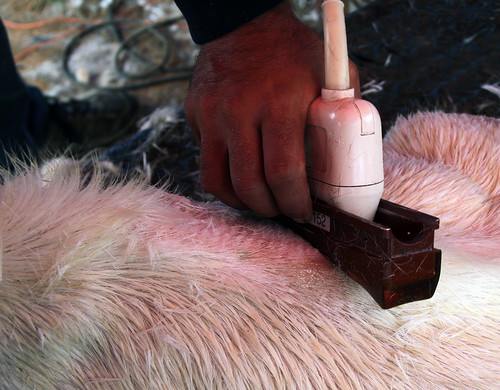
On September 1st, the goats were scanned to determine rib fat thickness and rib eye area. The scanning was done by Jim Pritchard from West Virginia University.  The data were processed by the National CUP (Centralized Ultrasound Processing) Lab & Technology Center in Ames, Iowa.

For the goats in the pasture test, rib eye area ranged from 0.55 to 1.76 square inches and averaged 1.00 square inch.  While the data reveal genetic differences in carcass muscling, the biggest effect on rib eye area is weight.  Thus, the following table organizes the rib eye data according to the weight of the goats. 


In the report, ratios are used to compare a buck's rib eye measurement to the average for bucks in his weight range, e.g. 50 to 59 lbs. The buck with the largest rib eye (according to ultrasound) is #71, a Kiko buck consigned by Mark Sweitzer (PA). This buck's 1.76 square inch rib eye is 50 percent better than the average buck in his weight group (60-70 lbs.).  What's more impressive is that this buck's weight is at the low end of the weight range:  61 lbs.

Another buck with a high ratio is #33, a Savanna x Spanish buck consigned by Stephen & Janet Garrett (VA).  This buck's 1.46 square inch rib eye is 46 percent better than the average buck in the 50 to 59 lb. weight group.  Randy & Lolli Allen (TN) have another buck with a high ratio. The rib eye of #6, a 75% Kiko buck, measured 1.62 square inches, 38.5 percent better than the weight group average.

Rib fat thickness ranged from 0.01 to 0.08 inches and averaged 0.037 inches. The rib fat thickness measurements are largely meaningless, as when past carcass evaluations have been performed, none of the goats have had enough fat over the rib to measure it.  Body wall thickness is measured instead and is considered a better measure of carcass fat.

The rib area is clipped before scanning

Even the goats in the feed pen did not measure with much rib fat. Their rib fat thickness ranged from 0.04 to 0.07 inches and averaged 0.052 inches.  Unless they are "overfed," goats do not deposit much external fat. In fact, they fatten differently than other livestock, fattening from the inside-out.  The more important measure of fat in a goat is kidney and heart fat (internal fat), which can only be measured by harvesting the goats.

For the nine goats in the pen, rib eye area ranged from 0.70 to 1.78 square inches and averaged 1.23 square inches. The higher average can be attributed to the heavier weights of some of the bucks. The buck with the largest rib eye is a crossbred Spanish buck consigned by Karen Cooper (KY).

One of the objectives of the carcass evaluation is to compare the ultrasound rib eye measurements with those measured on the carcass.  Another objective is to compare carcass muscling between pasture and pen-fed goats.

The purpose of the pen feeding has been to create a contemporary set of goats for carcass evaluation -- not to compare their growth performance and resistance to parasites.

Download ultrasound report

Tuesday, September 6, 2011

August pooled fecal sample

A pooled fecal sample was collected from random goats on August 4.  The sample was sent via overnite mail to the University of Georgia for analysis.

The fecal egg count of the pooled sample was 400 epg, compared to 450 epg for the pooled sample collected on July 7.  The average fecal egg count for individual fecal samples collected on August 4 was 338 epg.

For the pooled sample collected on August 4, ninety-three percent of the strongyle-type eggs were barber pole worm (Haemonchus contortus).  Six percent were Trichostrongylus.  The remaining 1 percent were Nematodirus.


A final pooled fecal sample was collected on September 1. The fecal egg count was 1,000 epg.  It takes about a month to get the results from the coproculture.

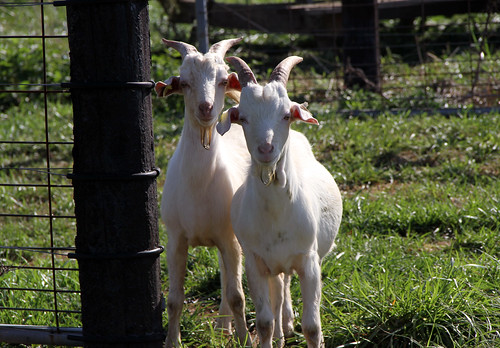
A pair of Kiko bucks

d-84 Leader Boards

The following tables show the top-performing bucks and top consignment of bucks as of day-84.

Top-performing bucks
Click on tables to view larger (clearer) versions
of tables in another browser window.


#34 (L) is currently ranked 2nd in the test.
Savanna x Spanish buck consigned by Janet & Stephen Garrett (VA)

Friday, September 2, 2011

Goats continue to gain weight

The goats posted moderate gains for the previous 14-day weigh period.  Gain ranged from -3.0 to +7.0 lbs. and averaged 2.3 lbs.  ADG ranged from -0.21 lbs. per day to +0.5 lbs. per day and averaged 0.161 lbs. per day.

Only six goats lost weight during the previous 14 days. Twelve goats maintained their weight.  More than three-quarters of the goats in the pasture test gained weight from August 18 until September 1.

Top-performing buck as of d-84
Kiko x Boer buck consigned by Luke Miller

Top-performers
The top-gaining goat for the weigh period was a Kiko buck consigned by Jarred Dennison (KY).  It gained 7 lbs. or 0.5 lbs. per day.  Five goats gained 6 lbs. or 0.428 lbs. per day.  These top-gaining goats were consigned by Craig Adams (IL), Luke Miller (IN), P.J. Murphy (NJ), Mike and Lorie Renick (WV),  and Mark Sweitzer (PA).

As of day-84, the top-gaining buck is a Kiko x Boer buck consigned by Luke Miller.  It is gaining almost 0.3 lbs. per day (0.298).  The buck with the second highest rate-of-gain is a Savanna x Spanish buck consigned by Janet and Stephen Garrett (VA). It is gaining 0.262 lbs. per day. These two crossbred bucks have been the top-performers throughout the test.

Day-84 ADG ranged from -0.071 to +0.298 lbs. per day and is averaging 0.136 lbs. per day.  Only one goat in the pasture test has failed to gain weight. Despite failing to gain weight, this buck is healthy and vigorous and has posted excellent scores for parasite resistance and resilience.

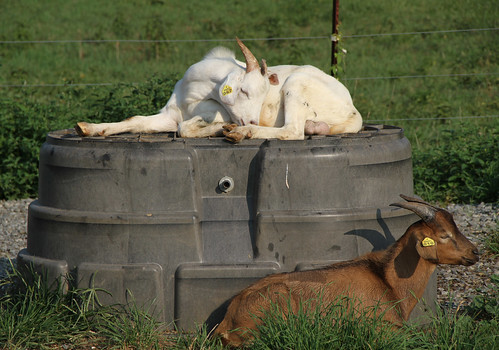
Relaxing after being worked

Four goats in the pasture test were dewormed with either moxidectin or levamisole.  FAMACHA© scores ranged from 1 to 3 and averaged 1.81 compared to 1.56 on August 18.  Higher FAMACHA© scores make sense as egg counts increased by about 500 epg between August 4 and August 18.

Body condition and coat condition scores remained stable.  No goat had a body condition or coat condition score below 2.0.  Only one goat in the pasture test had a positive dag core.  Only one goat was actively scouring. A pooled fecal sample was collected from random goats. The sample was sent to the University of Georgia for larvae ID.

Additional data
In addition to the normal data and sample collection, the goats were scanned by Jim Pritchard from West Virginia University to determine rib eye area and back fat.  The ultrasound scan data was sent to Iowa for processing.

The bucks were evaluated for reproductive traits and structural soundness.  Scrotal size was determined using a scrotal tape. Teats were counted and teat structure was noted.


Late-August grazing

The hooves of each goat were trimmed and evaluated to determine hoof growth and abnormalities. The feet and leg structure of each goat was evaluated.  Unlike evaluation in the show ring, only "functional" structure and mobility problems are noted. All of these data will be reported in a later blog entry.

The goats will be worked for a final time on Thursday, September 15. Sale bucks will be identified after this final day of data collection.

Grazing conditions are good. Moisture has vastly improved.  Hurricane Irene had no effect at the test site. After working, the goats were given access to the chicory field.  After grazing there for a few days, they will be returned to the pearl millet and/or cool season grass paddocks.

Penned goats enjoy their once-a-day grain diet

Pen goats
All of the goats being fed in the pen gained weight.  Gain ranged from 3 to 8 lbs. and averaged 4.7 lbs.  The goats in the pen are eating more grain.  Two that have been doing poorly are looking much better and are actively gaining weight.  ADG for the goats in the pen has ranged from -0.036 to 0.369 lbs. per day and is averaging 0.333 lbs. per day. The penned goats were also scanned to determine back fat and rib eye area.

Download d-84 (Sept 1) report