Friday, July 30, 2010

Top goats - day 42

These tables show the top-performing goats and top-performing consignments, as of day 42.

Top-performing bucks - day 42

Top consignments - day 42

Click on the table to view a larger version of the table in a new browser window.

Thursday, July 29, 2010

Goats post moderate gains on millet pasture

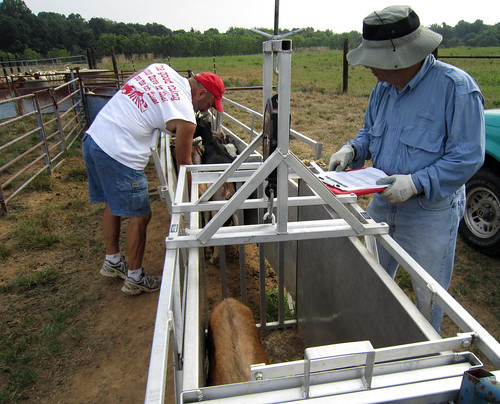
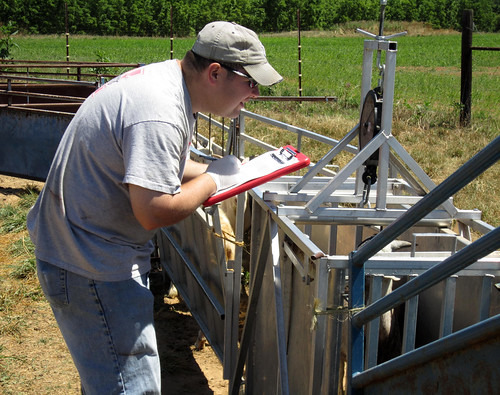
6:30 a.m. -- The goats were worked today by Jeff Semler, Mary Beth Bennett, E. Nelson Escobar, Jeanne Dietz-Band, and Susan Schoenian.  Data were recorded by Pam Thomas and Nelson Escobar.  Jeff Semler weighed the goats.  Susan Schoenian determined FAMACHA©, body condition, coat condition, and dag scores.

Individual fecal samples were collected from the rectum of each goat.  Samples were sent via overnight mail to Dr. Dahlia O'Brien's lab at Delaware State University for fecal egg count (FEC) determination.  A pooled sample (comprised of fecal samples from random goats) was sent via overnight mail to Dr. Ray Kaplan's lab at the University of Georgia for fecal coproculture.

Jeff Semler (L) and E. Nelson Escobar (R)

Moderate gains
During the past two weeks in which the goats were grazing dwarf pearl millet, gain ranged from  -8 to +9 lbs. for an average gain of 2.6 lbs.  Average daily gain ranged from -0.571 to 0.643 lbs. per day for an average of 0.184 lbs. per day.  Eighty-three percent of the goats posted positive gains. John Smith and Bill Lowe had the top-gaining goats for the period.

Twelve goats lost weight during the last two weeks, but only one goat lost significant weight.  His loss can be partially explained by his FAMACHA© and dag scores:  3 and 4, respectively.

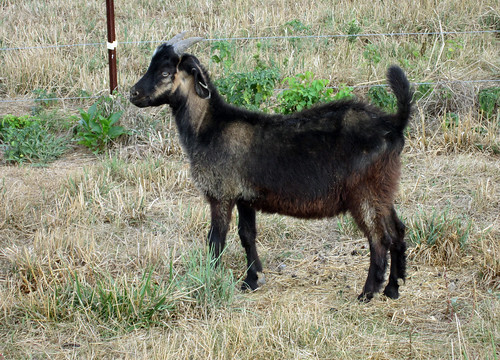
A top gainer:  #1 gained 8 lbs. in two weeks.

Top-gainers
For the first 42 days of the test, average daily gain (ADG) has ranged from -0.095 to 0.50 lbs. per day and averaged 0.185 lbs. per day.  So far, the top-gaining goat is a Kiko buck consigned by Craig Adams (IL).

Wes Pinneo (KS) has the top-gaining consignment.  His five Kiko bucks are gaining an average of 0.314 lbs. per day.  Other top consigners are Craig Adams, Sam Burke, and Bill Lowe. The five goats in each of their consignments are averaging around 0.3 lbs. per day compared to the test average of 0.185 lbs. per day.

Environmental enrichment

Strong FAMACHA©  scores
FAMACHA©  scores were very strong.  They ranged from 1 to 3 and averaged 1.5, compared to 1.7 two weeks ago.  Only two goats were dewormed with levamisole (Prohibit®  drench, 3 ml/50 lbs.).  Both had FAMACHA© scores of 3 and other indicators which suggested the the need for deworming.

Loose stools
Body condition scores ranged from 1.0 to 3.5 and averaged 2.5, compared to 2.6 two weeks ago.  Coat condition scores ranged from 1.5 to 2.5 and averaged 2.1, compared to 2.2 two weeks ago.  Dag scores ranged from 1 to 4 and averaged 1.7, compared to 1.4 two weeks ago. Almost half of the goats showed some evidence of current or past scouring. Some of this can be attributed to the fresh grass the goats have been grazing.

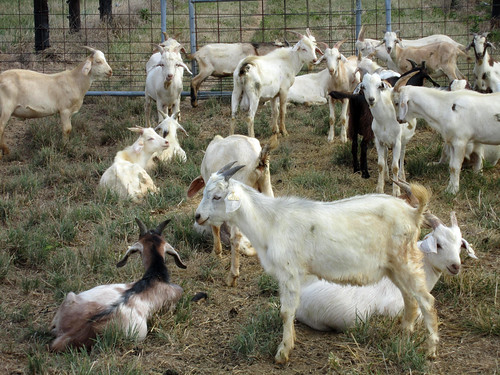
Waiting around

The two acre paddock of dwarf pearl millet is mostly depleted.  Without measurable rain, it is not likely to regrow.  Consequently, the entire pasture system has been opened for grazing. The goats still have access to a round bale of grass hay and protein tubs.  They still haven't touched the latter.

Monday, July 26, 2010

Still hot and dry

Weather conditions at the test site continue to be hot and dry. Not much rain has fallen since the test began in early June. Though today is a bit "cooler," temperatures have continued to be in the mid and upper 90's, sometimes above 100ºF. All sorts of temperature records are being broken in Maryland.

Grazing down dwarf pearl millet
The goats spend a considerable amount of time in their port-a-huts and hovered around the handling system. They are still grazing a two-acre field of dwarf pearl millet.  It is holding up well, but will not sustain the goats for too many more days.

The goats have still shown no activity with the protein tubs and have not been observed eating the round bale of hay.  The later is good because it shows that the goats are getting enough to eat in the pasture. 

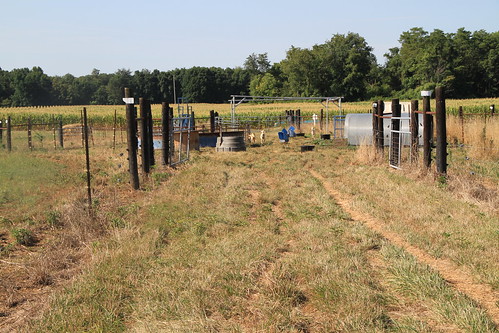
Central laneway
Low fecal egg counts
Individual fecal egg counts from July 15 ranged from 0 to 2,975 epg and averaged just 265 eggs per gram.  With the persistent dry conditions, low egg counts were anticipated. Coccidia oocytes were observed in 71 percent of the samples.

Only seven goats had fecal egg counts above 1,000 epg for an average of 1,906 epg.  Three of these goats had FAMACHA© scores of 3 and were dewormed with levamisole (Prohibit® drench, 3 ml/50 lbs.) on July 15.  Levamsiole treatments have successfully reduced fecal egg counts in goats that have required anthelmintic treatment. 

The test site received ~0.3 in. rainfall on 7/25 (p.m.).
Australian researchers have developed a Moisture Index to predict the development success of the barber pole worm. While temperatures have been mostly optimal (77º to 95ºF) for development from egg to larvae, the lack of moisture is severely limiting the development success of the barber pole worm at the test site.

On Thursday, another pooled fecal sample will be collected to determine the composition of the worm load.  However, if the egg count is too low, it may not be possible to make this determination.  The July 1 pooled sample contained 100 percent Haemonchus (barber pole worm) eggs.

Wednesday, July 21, 2010

Dr. Paul Kuber confirmed as field day speaker

Dr. Paul Kuber has been confirmed as the keynote speaker for the 2010 Western Maryland Goat Field Day & Sale.  The Annual Field Day and Sale will be held on Saturday, October 2nd at the Washington County Agricultural Education Center near Boonsboro, MD.

Dr. Paul Kuber
(Ohio State University image)
Dr. Kuber is an Associate Professor in the Department of Animal Science at The Ohio State University. He holds a split appointment that spans teaching, research, and extension (for both adult and youth audiences). 

A native of California, Dr. Kuper received his B.S. from California State University-Fresno and his M.S. from the University of Nebraska. His Ph.D. was in Meat Science from Washington State University. Dr. Kuber has considerable experience in the meat industry, including two years spent in Australia procuring lambs for Superior Farms.

During the field day, Dr. Kuber will demonstrate cuts from a goat carcass, talk about potential standards, and prepare products for tasting. It will be an interactive session that will allow participants to ask questions and discuss potential answers with Dr. Kuber.

The Field Day will be held in conjunction with the sale of the top-performing bucks from the Western Maryland Pasture-Based Meat Goat Performance Test.  There will also be an invitational doe sale and a Junior Goat Skillathon

Visit Dr. Kuber's web page

Monday, July 19, 2010

Consigner serves goat to Governor

Goat made an impressive showing at Maryland Governor Martin O'Malley's Buy Local Cookout. Governor O'Malley sponsored a cookout for 250 invited guests featuring local chefs, farms, and restaurants that submitted recipes that feature fresh Maryland grown ingredients.

Governor Martin O'Malley
This year, 50 recipes were submitted and 15 won the competition to go to Annapolis and serve their winning dishes at the cookout held on the lawn of the Governor's mansion to signify the kick off of Maryland's Buy Local Challenge Week.

Maryland goat was featured in two of the winning recipes, Black Currant and Onion Conserve served on goat cheese and goat sausage (Many Rocks British-Style Goat Banger sausage) and Washington County Head Buttin' Goat Chili featuring Eye of Goat Beans.

Through farmers markets and other local events such as this, Jeanne Dietz-Band (Many Rocks Farm) is helping members of the public to discover that goat is a wonderful and tasty addition to a healthy diet for their families.

Many Rocks Farm has been a consigner to the Western Maryland Meat Goat Performance Test since its inception in 2006.  They had the top-performing buck in 2006 and have had one or more bucks in the top ten each year.

Read article in Hagerstown's Herald-Mail


"The domestic goat meat industry will grow and succeed one bite of deliciously prepared goat at a time. Getting out there and demonstrating to consumers that a fresh local meat product far surpasses imported goat meat in flavor and quality is also key to the growth of our industry." 

Jeanne Dietz-Band, Many Rocks Farm 
        

Friday, July 16, 2010

More fecal data

Individual fecal egg counts varied from 0 to 12,320 eggs per gram and averaged 1,161 epg on July 1.  Twenty goats had fecal egg counts above 1,000 epg, for an average of 2,828 epg. 

These twenty goats had an average FAMACHA© score of 1.9, not much higher than the test average of 1.8 on July 1.  These same goats had an average FAMACHA© score of 1.85 on July 15, only slightly higher than the test average of 1.68.

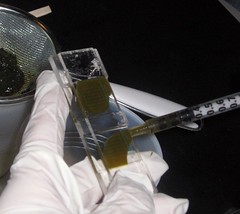
Filling a McMaster slide
The goats with the three highest fecal egg counts (12,320, 10,800, and 7,300 epg) on July 1 had FAMACHA© scores of 3 and were dewormed with levamisole (Prohibit® drench, 3 ml/50 lbs.). By July 15, their FAMACHA© scores had improved by 1 to 2 scores.

The pooled fecal sample collected on July 1 had a fecal egg count of 2,165 epg.  One hundred percent (100%) of the worm larvae were identified as Haemonchus contortus (the barber pole worm).  The next pooled fecal sample will be collected on July 29.

Coccidia (Eimeria sp.) were noted in all of the individual fecal samples. Some coccidia oocytes were observed in the pooled sample.

Download July 16 fecal report

Top goats - day 28

Hold down the Control key and hit the Plus (+) key to make the table(s) larger in your browser window.  Click on the table to view it in a new window.


Thursday, July 15, 2010

Goats maintain weight during hot spell

6:30 a.m. -- The goats were worked today by Jeff Semler, David Gordon, Mary Beth Bennett, and Susan Schoenian. Data were recorded by Pam Thomas and David Gordon.  Jeff Semler weighed the goats.  Susan Schoenian determined FAMACHA©, body condition, coat condition, and dag scores.

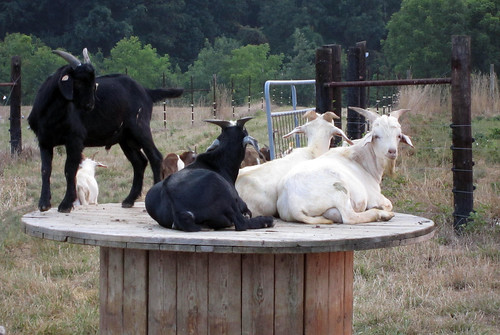
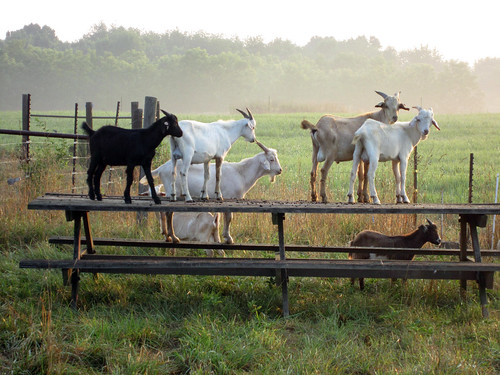
Up on the picnic table
Individual fecal samples were collected from the rectum of each goat.  Samples will be sent via overnight mail to Dr. Dahlia O'Brien's lab at Delaware State University for fecal egg count (FEC) determination.

No gain
During the past two weeks in which record high temperatures were recorded in Western Maryland, most of the goats simply maintained their body weight and condition.  On-average, the goats gained less than 1 lb. during the past two weeks: 0.62 lbs.or 0.04 lbs. per day.  Among individual goats, gain ranged from -7 to 10 lbs. or -0.5 to 0.714 lbs. per day. 

Field of dwarf pearl millet
The goat that lost 7 lbs. had been treated for scours during the previous week.  The goat that gained 10 lbs. seems to have recovered from Haemonchosis. His high rate-of-gain is attributed mostly to compensatory gain.  It's unclear why two goats lost 6 lbs.  Variations in fill probably accounted for some of the losses. Only eight goats lost more than 1 lb. during the past two weeks.

For the first 28 days of the test, average daily gain (ADG) ranged from -0.143 to 0.571 lbs. per day and averaged 0.164 lbs. per day (75 g/day).  So far, the top-gaining goat is a Kiko buck consigned by Craig Adams (Illinois).  Wes Pinneo (Kansas) has the top-gaining consignment.  Pinneo's five Kiko bucks gained an average of 0.359 lbs. per day for the first 28 days of the test.

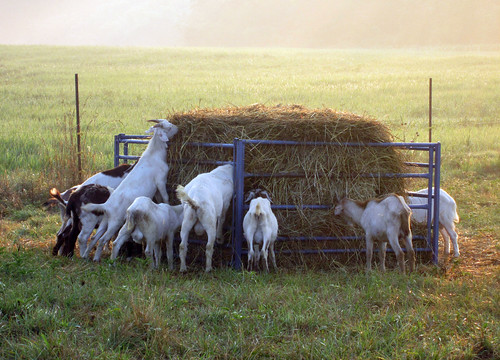
Supplemental hay

7 goats dewormed
FAMACHA© scores (1-5) ranged from 1 to 4 and averaged 1.68 compared to 1.80 two weeks ago. Seven goats were dewormed with levamisole (Prohibit® drench, 3/ml/50 lbs). Due to the early worm problems and questionable efficacy of the initial double-deworming, goats with FAMACHA© scores of 3 continue to be dewormed.  Only one goat had a FAMACHA© score of 4.  There were no 5 FAMACHA© scores.

Body condition scores (1-5) ranged from 1.5 to 3.5 and averaged 2.51, similar to two weeks ago. Body condition scores below 2 are often cause for concern.  Coat condition scores (1-3) ranged from 1.5 to 3.0 and averaged 2.19 compared to 2.14 two weeks ago.  Dag scores (1-5) ranged from 1 to 3 and averaged 1.41 compared to 1.49 two weeks ago.  No goats appeared to be actively scouring.  Two-thirds of the goats show no evidence of scouring at all.

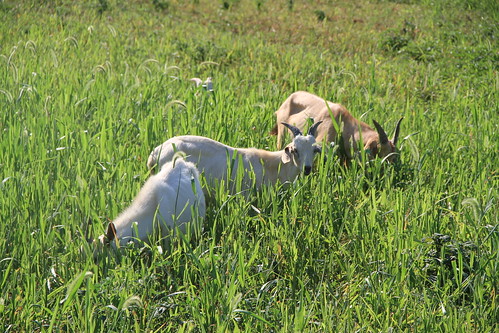
Green grass

Better weather conditions
The heat spell broke last weekend. Temperatures are now more characteristic for Maryland (low 90's), though the level of humidity has increased, which is also characteristic for Maryland.  While varying amounts of rain have been falling throughout the state since last Friday, the test site has received less than 1 inch of rain since July 1.  The condition of the cool season grass pastures (5 acres) is still poor.

The dwarf pearl millet (Pennisetum glaucum) was deemed ready for grazing, so the goats now have access to two acres of lush green grass. Last Friday, a round bale of grass hay was put in the pasture.  The goats have access to it, and they have been feeding on it.  They have not consumed anything from the protein tubs.


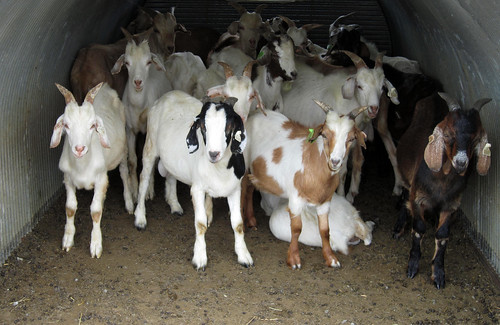
In the port-a-hut

Friday, July 9, 2010

Consigner featured in The Delmarva Farmer

Merritt "Sam" Burke and his son Laurence were recently featured in an article in The Delmarva Farmer and The New Jersey Farmer. The article appeared in "New Directions," a supplement to the two publications that serve the Mid-Atlantic farming community.

Laurence and Sam Burke
(Image by The Delmarva Farmer)
The Burkes raise Kiko goats, Scottish Highland cattle, Katahdin sheep, and a few turkeys on their 160-acre property in Delaware. They have participated in the goat test since 2007. Last year, they had the top-gaining buck on test.

Download supplement to read full article

Thursday, July 8, 2010

Coccidia

Coccidia (eimeria sp.) is a common parasite among weanling goats.  It can affect goats kept in confinement, as well as those that are raised on pasture.  Coccidia are species-specific, meaning the coccidia that affect goats are different from the coccidia that affect other animals, including sheep.

Coccidia oocytes (eggs) were present in 71 percent of the individual fecal samples collected on June 4-5.  Sixty-one percent of the samples collected on June 17th contained coccidia oocytes.  It is normal for goat feces to contain some coccidia eggs.

The goats were treated for coccidia during the first five days of the test.  Amprolium (Corid) was mixed in the water.  The goats always have access to free choice loose minerals (16:8 MeatMaker®) containing a coccidiostat:  monensin (Rumensin®).  Several mineral feeders are situated in the central laneway. 

This year, minerals are being provided by Sweetlix® Livestock Supplements.  Visit their web site to learn more about their products for goats.

Download July 2 fecal report

Tuesday, July 6, 2010

First fecal data

While most of the goats are doing well, some have experienced some unexpected parasite problems during the first month of the test.  Fecal data may help to explain some of these unexpected problems.

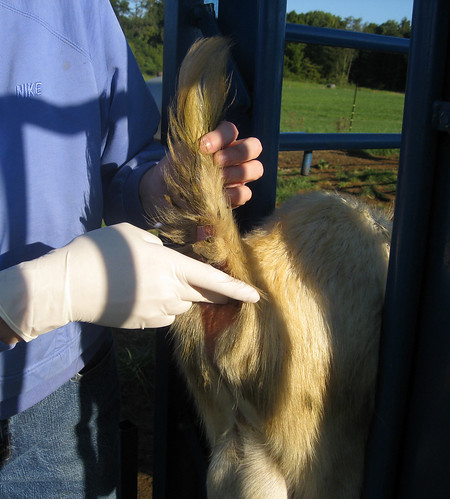
Upon arrival and every two weeks, individual fecal samples are collected from the rectum of each goat.  A second fecal sample is collected from every third goat.  These random samples are combined to form a pooled sample. If a fecal sample cannot be obtained from a goat, the goat is put in a pen and re-checked later in the morning. Usually, a sample is obtained from the second attempt.
Deteriorating pasture conditions

The pooled sample is sent via overnight mail to Dr. Ray Kaplan's lab at the University of Georgia.  After determining a pooled fecal egg count, the eggs are hatched. This takes about two weeks, after which time the larvae are identified to determine the type of parasites that are infecting the goats. Pooled samples are collected every 4 weeks.

From the fecals that were collected on June 4-5, the pooled fecal egg count was 1,100 epg.  Eighty percent of the eggs were Haemonchus contortus (barber pole worm).  Fifteen percent were Trichostrongylus; 5 percent were Nematodirus.  Some trichuris and monezia (tapeworm) eggs were also observed in the sample.  The pooled sample from July 1 had an egg count of 2,165 epg.  Culture data for the July 1 sample will be available around July 14.

Individual fecal samples are collected in individual bags (on ice) and sent via overnight mail to Dr. Dahlia O'Brien's lab at Delaware State University.  Individual fecal egg counts are determined using the Modified McMaster technique. At the start of the test, individual egg counts ranged from 0 to 5,067 epg and averaged 682 epg.
Collecting a fecal sample

While the average fecal egg count wasn't very high, fifteen goats had egg counts above 1,000 epg for an average of 2,435 epg.  Egg counts on June 17 ranged from 0 to 7,033 epg and averaged 562 epg.  Nine goats had egg counts above 1,000 epg for an average of 3,135 epg.

The efficacy of an anthelmintic (dewormer) is determined by comparing fecal egg counts pre- and post-treatment.  Upon arrival to the test site, the goats were dewormed with albendazole (Valbazen®, 6 ml/100 lbs) and moxidectin (Cydectin®  1% injectable, 1 ml/110 lbs.)  For the 72 goats that started the test, this initial double-deworming only reduced fecal egg counts by an average of 18 percent. 

For those goats that had fecal egg counts above 1,000 epg, the double-deworming only reduced egg counts by 28 percent.  In the past, the initial dewormings have reduced egg counts by 95% or more. In previous years, levamisole (Prohibit®) was used instead of albendazole. This year, levamisole was not available at the start of the test. Now, it is available in limited supply and the test was able to obtain several packets of drench powder.
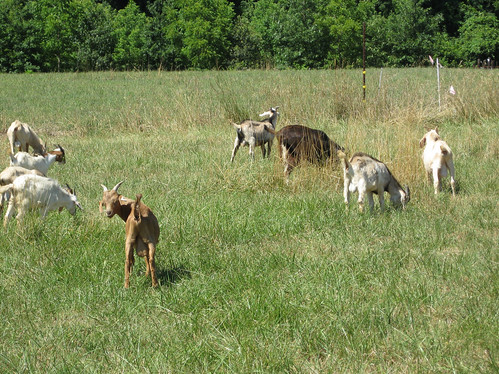
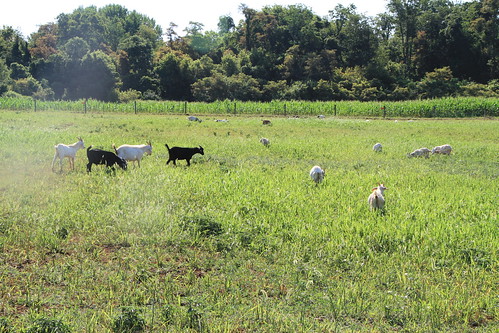
Grazing cool season grass pasture

These fecal data suggest that some of the parasite problems experienced by individual goats may be due to anthelmintic (dewormer) resistance.  It is known that worms have developed resistance to all of the available dewormers.  Resistance varies by farm and past anthelmintic use.

Any goat that becomes parasitized is further stressed by the heat and humidity.  It has been very hot at the test site. Temperatures of 100ºF are expected this week, with no relief in the forecast.  Forage quality is probably poor due to the continuing dry weather. This is why protein tubs were made available to the goats a few days ago. 

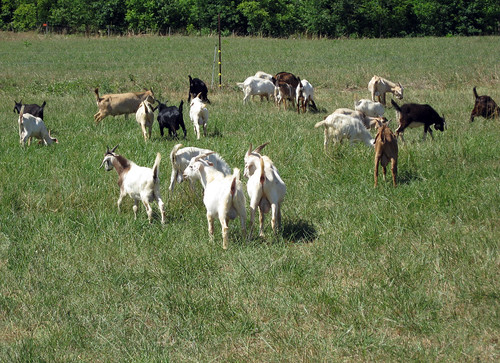
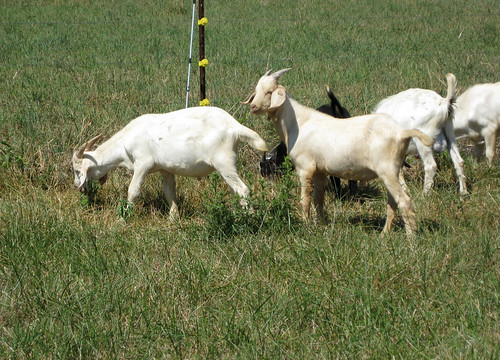
In addition, the goats are grazing all (cool season) grass pastures, which increases the chances of them ingesting infective worm larvae. The pearl millet is not ready for grazing and the chicory and weed pastures have not received any moisture since they were mowed.

Friday, July 2, 2010

Protein tubs

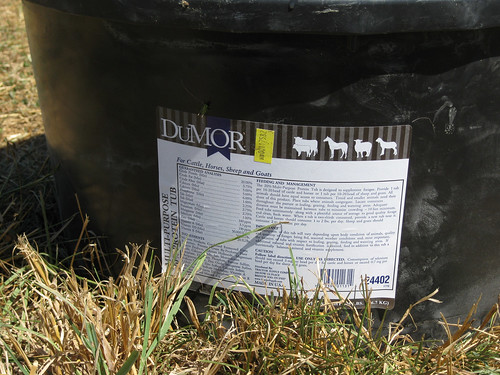
Due to dry weather and rapidly deterioriating pasture conditions, three multi-purpose protein tubs have been put in with the goats.  The protein tubs contain 20 percent all-natural protein.  According to the product label, the goats should consume 2 to 4 ounces per day. 

Protein tub

The tubs were placed in the central laneway where the goats congregate.  They are spread out to make sure all the goats get a chance to consume them.  So far, the goats haven't shown much interest. There is still ample forage, though it is getting brown and "crispy."

The test site received 1.02 inches of rainfall in June, compared to 4.17 inches last year.  June 2010 is the driest June on record at the research center.  Rainfall records have been kept since 1980.  Last year, 6.22 inches of rain fell in July.  Let's hope we get a repeat of last year.  Or at least some of it.

DuMOR multi-purpose protein tub

Protein tubs are advocated for livestock when forage quality is poor.  In addition to providing supplemental nutrition, research has shown that their use may improve forage utilization. The 125-lb. tubs were purchased from Tractor Supply Company.

Thursday, July 1, 2010

Good gains

7:00 a.m. -- The goats were worked today by David Gordon, Mary Beth Bennett, Jeanne Dietz-Band, and Susan Schoenian.  Data were recorded by Pam Thomas.

Goats gain well
For the first 14 days of the test, the goats gained an average of 4.4 lbs (2.2 kg) or 0.315 lbs. (143 g) per day.  Gain ranged from -5 to + 13 lbs. or -0.375 to 0.929 lbs. per day.  Only three goats lost weight.  Two goats neither gained nor lost weight. The three goats that lost weight either have or had poor FAMACHA© scores.  David Gordon determined weights. 

David Gordon weighs a goat.
FAMACHA©, body condition, coat condition and dag scores were determined by Susan Schoenian.  Individiual and pooled fecal samples were collected from the goats.  So far, the only fecal data that has been received indicated a pooled fecal egg count of 1,100 eggs per gram on June 5.

13 goats dewormed
FAMACHA© scores (1-5) ranged from 1 to 5 and averaged 1.8, compared to 1.6 two weeks ago. While only two goats had FAMACHA© scores of 4 or 5, thirteen goats were dewormed. 

Due to early unexpected parasite problems among some goats, the decision was made to deworm goats with FAMACHA© scores of 3 or greater.  It was also decided that levamisole drench would be used for deworming (instead of moxidectin). 

Levamisole
The general recommendation (by small ruminant parasitologists) is that goats receive 1.5 times the labeled sheep dose of levamisole. This cautious recommendation is due to the narrower margin of safety for the drug. Off the market for approximately two years, levamisole (Prohibit® sheep drench) is now available in limited supply.

Cool season grass pasture

Body condition scores (1-5) ranged from 1.5 to 3.5 and averaged 2.6.  A few of the parasitized goats lost significant body condition.  Coat condition scores (1-3) ranged from 1.5 to 3.  Lower scores are usually due to lice or dandruff. Dag scores (1-5) ranged from 1 to 5 and averaged 1.5.  Dag scores of 4 or 5 are usually indicative of active scouring (diarrhea).

Dry conditions
Pasture conditions at the test site are rapidly deteriorating due to the dry weather.  After a reasonably wet spring, the test site receive very little rainfall in June.  Cool season grasses turn brown and cease growing very quickly in a drought.  On the other hand, if there is enough variety (and pasture), goats, as selective grazers, tend to fare well in a drought.  They currently have access to several paddocks. 

Growing pearl millet
A two-acre field of dwarf pearl millet (pictured above), a summer annual grass, is not yet available for grazing, but could prove to be very important for this year's test. If the dry weather conditions persist, supplemental nutrition may be necessary (e.g. nutritional tubs and/or hay).  Pray for rain!