Thursday, July 28, 2011

100 percent barber pole worm

A pooled fecal sample was collected from the goats on July 7.  The sample was random, with feces being obtained from approximately every third goat worked.

The sample was sent via overnite mail to Dr. Ray Kaplan's lab at the University of Georgia, College of Veterinary Medicine, Department of Infectious Diseases.

After determining the fecal egg count of the pooled sample, the eggs were allowed to hatch.  The specific types of parasites in the sample were differentiated by examining and measuring the resulting larvae.

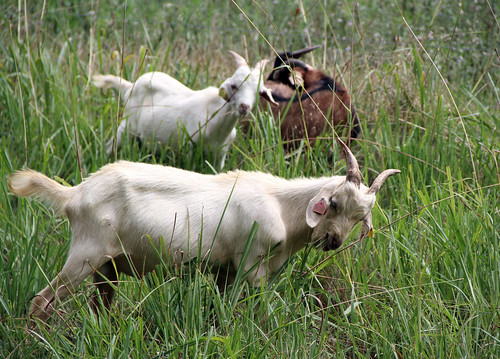
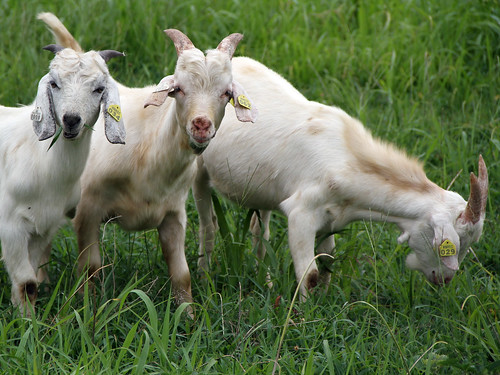
Caught with a mouthful

The fecal egg count for the pooled sample collected on July 7 was 450 epg, compared to 350 epg from the pooled sample collected on June 3-4 when the goats arrived to the test site.

One hundred percent of the strongyle-type (roundworm) eggs in the July 7th sample were determined to be barber pole worm (Haemonchus contortus), compared to 81 percent from the pooled sample collected on June 3-4.  Trichostrongylus was the other species found in the first pooled sample.

"Traces" of coccidia (Eimeria spp.) were also observed.  In the first pooled sample, a "moderate" (3+) amount of coccidia oocytes was observed.  Clinical coccidiosis was suspected in a few of the goats during the first half of the test.

It is difficult to completely prevent coccidiosis, as control and prevention depend upon adequate consumption of the drug or coccidiostat in the water or mineral. Next year, we plan to give each goat an individual treatment for coccidia upon arrival to the test site.

Download Fecal Egg Count/Culture ID  Report

Monday, July 25, 2011

Goats gain weight on millet

For the third weigh period, the goats gained similar to the second weigh period, gaining an average of 2 lbs. or 0.154 lbs. per day over the previous 13 days .

The goats were worked early am on July 20 (a day early) by Susan Schoenian, Jeff Semler, Jeanne Dietz-Band, David Gordon, and Pam Thomas. Jeff weighed the goats. Susan scored the goats, and Pam recorded the data.

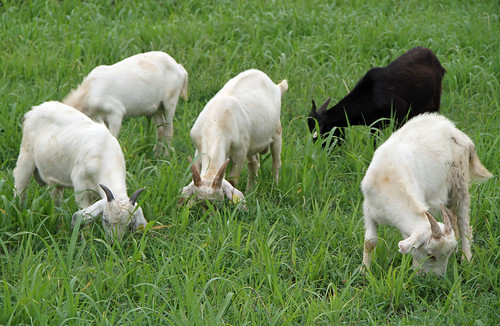
Chowing down

Gain from July 7 through July 20 ranged from -7.0 to +11.0 lbs. for individual goats.  Looking at it another way, ADG ranged from -0.538 to + 0.846 lbs. for the 80 goats in the pasture test.  Twelve goats lost weight, while 68 posted positive gains.

The goats had been grazing a clean, lush pasture of dwarf pearl millet, so positive weight gains were expected.  However, "extreme" weight gain or loss cannot be easily explained.

The top-gaining goat for the period was a Kiko buck consigned by Mark Sweitzer (PA). It gained an incredible 11 lbs.  Craig Adams (IL) and Randy Allen (TN) also had bucks than gained more than 0.5 lbs. per day during the weigh period. Merritt Burke (DE) had two bucks that topped 0.5 lbs. per day.

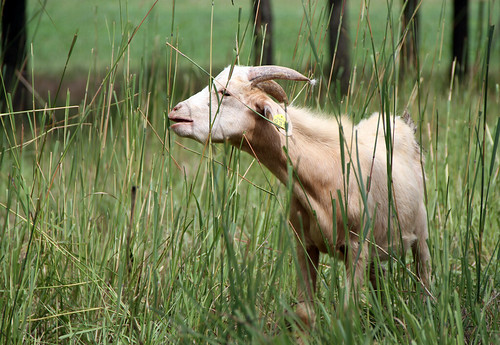
Using his lips

A goat consigned by Janet and Stephen Garrett (VA) remains the top-gaining buck in the test, as of day 42.  The Spanish x Savanna buck has gained 14 lbs. since June 10.  His average daily gain is 0.341 lbs.

The second and third top-gaining goats were Kiko bucks consigned by Merritt "Sam" Burke (DE).  In fact, as of day 42, Burke has the top consignment of bucks.  His five Kiko bucks are gaining an average of 0.259 lbs. per day.

Internal parasites
FAMACHA© scores ranged from 1 to 4 and averaged 1.56, compared to 1.62 on July 7.  Collectively, body condition, coat condition, and dag scores did not vary significantly from July 7.  Few goats had positive dag scores and only two required treatment for scours.  Four goats were dewormed with levamisole® (Prohibit @ 3 ml/50). Goats with FAMACHA© scores of 3 were dewormed, if other scores supported the decision.

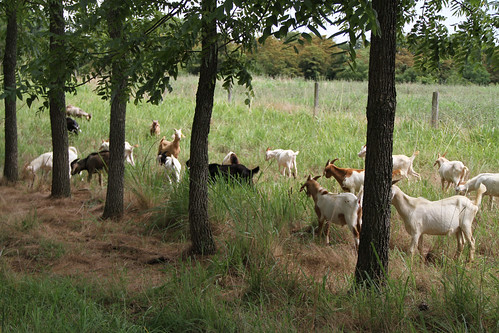
Under the trees

Fecal egg counts for July 7 ranged from 0 to 3,400 and averaged 606 epg, compared to 138 epg on June 23.  Eighteen goats had fecal egg counts above 1,000 epg. Only 6 goats had fecal egg counts above 2,000. Another individual fecal sample was collected from each goat on July 20.

After being worked, the goats were given access to the silovpasture, about 2 1/2 acres of cool season grasses with some warm season grass planted amongst walnut trees and mixed hardwoods. This pasture provides the most shade, an important consideration for the current spell of very hot weather.

Here they come

Penned goats
For the ten goats in the pen, gain ranged from -1.0 to +6.0 lbs. for the period. The average gain was 2.4 lbs. or 0.171 lbs. per day.  Some of the goats in the pen are performing very well; others, less so. The penned goats have free choice hay, but are only getting the amount of grain (pellets) that they can eat in 20 minutes time.

The goats will be worked next on August 4.

July 20 (d-42) report

Tuesday, July 19, 2011

About this year's bucks

The goats that participate in the test come from many different consigners from many states. They represent many different breeds or crosses and prior to entering the test have experienced many different management schemes. Here's a summary of this year's bucks:

Number consigned - 81
Number of consigners - 23
Number of states represented - 11
State with most consigners - Maryland (6)
State with most goats - Maryland (19)


Breed
Boer - 4
Percentage Boer - 2
Boer x Kiko - 4
Kiko x Nubian - 1
Kiko - 9
Kiko x Spanish - 2
New Zealand Kiko - 3
Percentage Kiko - 14
Purebred Kiko - 23
Myotonic - 5
Savanna x Kiko - 4
Savanna x Spanish - 2
Spanish - 6


Boer-influenced - 10 (12.3 percent)
Kiko- influenced - 60 (74.1 percent)
Savanna-influenced - 6 (7.4 percent)
Spanish-influenced - 8 (9.9 percent)

Birth type
Singles - 15 (18.5 percent)
Twins - 48 (59.3 percent)
Triplets - 14 (17.2%)
Unknown - 3 (3.7 percent)

Creep feeding
Not creep-fed 62 (76.5 percent)
Creep-fed - 16 (19.8 percent)
Unknown - 3 (3.7%)

Age and birth
Age range:  82 to 146 days (2.7-4.9 months)
Birth date range:  January 15 - March 20, 2011
Average age:  113 days (3.8 months)
Average birth date:  February 17, 2011

Download buck information

Saturday, July 16, 2011

PA Performance Tested Buck Sale

The annual Pennsylvania Performance Tested Buck (and Ram) Sale and Invitational Doe (and Ewe) Sale will be held on Saturday, August 6, 2011, at the Livestock Evaluation Center in PA Furnace, PA.

An index is used to rank the bucks and determine sale order.  The bucks are evaluated for average daily gain, lifetime weight per day of age, muscling, and fat thickness.  Approximately the top 75 percent of each breed or breed group will sell.

While on test, the bucks have free-choice access to a commercial concentrate diet (min. 16% protein) and a grass-alfalfa mixed hay. 

For more information, contact Glen Hubbard at (814) 238-2527 or ghubbard@state.pa.us.

Friday, July 15, 2011

Corrected data

Some formula errors were discovered in the spreadsheet that is used to store and calculate data for the Goat Test. The formulas had been used to calculate averages for the 80 goats in the pasture test.

On June 3-4, the average weight of the goats was 40.9 lbs., not 35.4 lbs., as previously reported.  On June 10, starting weights averaged 42.4 lbs., not 36.4 lbs., as previously reported.

A Myotonic and Kiko

FAMACHA©, body condition, coat condition, and dag scores were also slightly different than previously reported data.

The following reports and narratives were corrected with the new data:

June 4 report
June 10 report
June 10 report with fecal data

Please let Susan know if you ever see errors or discrepancies in the reports or blog.

Monday, July 11, 2011

Grazing pearl millet

The goats began grazing a two-acre paddock of dwarf pearl millet on Thursday, July 7. In addition to providing nutritional feed, the field would have been free from infective worm larvae, i.e. until the first goat pooped! Hopefully, the goats will be able to put on some meaningful gains during this weigh period. They will be weighed next on July 20, a day early, due to a scheduling conflict.

A clean pasture
Proud Kiko buck (from West Virginia/Renick)

Plenty of grass
Top gainer, d-28 - Savanna-X (from Virginia/Garrett) 
Three studs
Boer vs. Kiko
A difference of opinion

While the situation is not as bad as last year, the test site has grown dry.  There is still another fresh paddock that the goats will be able to graze.  This paddock was added to the test last year.  It is a silvopasture of about 2 1/2 acres. It contains plantings of walnut trees and mixed hardwoods. The forages are cool season grasses.  The two acre field of (mostly) chicory could use some moisture to get it re-growing. The other cool season grass paddocks have some regrowth.

Moisture is also desirable for the parasites.  The barber pole worm requires warmth and moisture to complete its life cycle.  In order to compare the goats for parasite resistance (fecal egg counts) and parasite resilience (FAMACHA© and Five Point Check©), a significant parasite challenge is needed.  

Thursday, July 7, 2011

Goats post modest gains

For the second weigh period, the goats posted modest gains, an average of 2.1 lbs.  Among individual goats, the two-week gain ranged from -3 to 7 lbs. Only seven goats lost weight since June 23. Looking at it another way, average daily gain (ADG) ranged from -0.21 to 0.50 lbs. per day and averaged 0.15 lbs. (68 g) per day.

For the period, the top-gaining goat was a Kiko buck consigned by P.J. Murphy (New Jersey).  Four bucks gained 0.36 lbs. per day for the period.  The consignors of these top-performing bucks are Randy Allen (Tennessee), Merritt Burke (Delaware), Kentucky State University, and Hannah Zitta (Virginia).

P.J. Murphy's top-gaining Kiko buck
(cell phone image by Jeff Semler)

Day 28

For the first 28 days of the test, ADG ranged from -0.19 to 0.37 lbs. per day and averaged 0.103 lbs. (47 g)  per day.  Nine goats have failed to gain weight since June 10.

So far, the top-gaining buck is a Savanna buck consigned by Janet & Stephen Garrett (Virginia). The top consignor is Lucas Miller (Indiana).  His three Boer x Kiko bucks have gained an average of 0.22 lbs. (100 g) per day. The second best consignment is from Merritt Burke.  Burke's five Kiko bucks have gained an average of 0.20 lbs (91 g) per day since June 10.

Other scores
On July 7, FAMACHA© scores ranged from 1 to 3 and averaged 1.62, compared to 1.74 on June 23.  Only two goats required anthelmintic treatment. While their FAMACHA© scores were only 3, other factors led to the decision to deworm. A few other goats with FAMACHA© scores of 3 were not dewormed, because they had good Five Point Check© scores.

Dag scores continued to improve.  Fecal tags were dry and the goats' feces were pelleted.  Only one goat showed any signs of scouring and had a positive dag score.  Average body condition and coat conditions scores improved slightly. Only one goat had a body condition and coat condition score below 2.0.

Couple of Boer bucks

June 23 fecals

For the fecal samples collected on June 23, fecal egg counts (FECs) ranged from 0 to 1,675 epg and averaged 138 epg.  No goat had what would be considered a very high egg count. While 1,675 epg may seem like a high count, barber pole worms lay a lot of eggs. In fact, 2,000 epg is considered clinically significant for the barber pole worm. At the same time, you'd prefer to have a buck that is shedding the least amount of eggs onto the pasture.

Tapeworm eggs and coccidia oocytes were observed in some of the individual fecal samples.  The tapeworm eggs are not of concern and the presence of coccidia oocytes in the fecal samples is not unexpected; nor can it be interpreted, as not all coccidia are pathogenic or equally pathogenic.

In addition to individual fecal samples, a pooled fecal sample was collected from random goats. This sample was sent to the University of Georgia for larvae identification. Pooled samples will be collected every 4 weeks during the test period. It takes several weeks to get the results of the testing.

Boer x Kiko buck from Maryland

Fecal egg count reduction

The double deworming (of moxidectin + levamisole) given to all the goats on June 10 was determined to be 80 percent effective. On June 10, sixty-one goats with non-zero egg counts had an average fecal egg count of 918 epg. On June 23, the average egg count had been reduced by 80 percent to 181 epg.

The effectiveness of the anthelmintic treatment varied by consignor and individual goats. In some cases, fecal egg counts went up after the anthelmintic treatment. Consignors should look at the data from their bucks to determine the level of anthelmintic resistance that may be present in their herds.

For an anthelmintic treatment to be considered effective, it should reduce egg counts by 90 percent or more (preferably 95 percent).  No anthelmintic treatment will be 100 percent effective, which is why drug resistance is inevitable and a growing problem.

Fresh pasture
After being worked, the goats were given access to a fresh 2-acre paddock of pearl millet.  This is both a clean pasture and a lush pasture.  The goats will be allowed to removed half of the forage before being rotated to another paddock.  This nutritious pasture should allow the goats to continue to gain weight.  At the same time, overall pasture conditions have deteriorated due to the scarcity of rainfall. Hopefully, this situation will not continue and worsen. 

Penned goat (from Kentucky)

Penned goats

The goats in the pen had similar data as the bucks in the pasture test.  On average, the pastured goats have gained better, but this is probably because the penned goats gained more weight during the adjustment period.

In a pen feeding situation, dominant goats can also be more of a problem. Goats that are too submissive will not get their fair share of grain. Dominance is a bigger factor in a confined feeding system.

The goats were worked today by Jeff Semler, David Gordon, Mary Beth Bennett, Jeanne Dietz-Band, and Susan Schoenian. Data were recorded by Pam Thomas. The next work day is July 21.

Download July 7 report