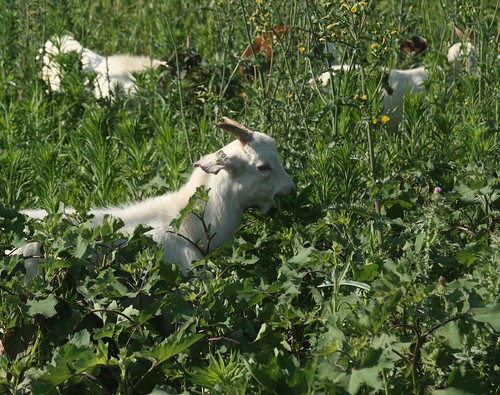
6:30 a.m. -- The goats were worked today by Jeff Semler, Willie Lantz, Mary Beth Bennett, Jeanne Dietz-Band, and Susan Schoenian.
FAMACHA©, body condition, and coat condition scores were determined by Susan Schoenian. Data was recorded by Pam Thomas. Individual and pooled fecal samples were collected and sent via overnite mail to Delaware State University and the University of Georgia, respectively.
 Jeff Semler weighed the goats. For the previous 14-day period, weight gain (or loss) ranged from -6 lbs. (2.7 kg) to +5 lbs. (2.3 kg) and averaged 1.1 lbs. (0.5 kg) or 0.075 lbs. (34 g) per day.
For the period, three bucks tied for having the highest amount of gain: 5 lbs. or 0.357 lbs. per day. The top-performing bucks for the period were consigned by Kendell and Dana Barnes (KY), Jeanne Dietz-Band (MD), and Don Smith (VA).
For the first 42 days of the test, the top gaining goat is a Kiko buck consigned by Merritt Burke (DE). It has gained 17 lbs. (7.7 kg) or 0.405 lbs. (184 g) per day since June 20.
For all sixty goats, weight gain (or loss) for the first 42 days ranged from -10 lbs. (4.5 kg) to + 17 lbs. (7.7 kg) and averaged 5.2 lbs (2.4 kg) or 0.125 lbs. (56.8 g) per day.
 Today's FAMACHA© eye anemia scores ranged from 1 to 3 and no goat required anthelmintic treatment. The average FAMACHA© score was 2.2 compared to 2.1 two weeks ago. Weather conditions are "perfect" for development of the barber pole worm. Last year, fecal egg counts, FAMACHA© scores, and the need for anthelmintic treatment peaked on August 30.
We await more parasite data. No new data has been received since the results from the June 18 fecal collections.
Download July 30 report
FAMACHA©, body condition, and coat condition scores were determined by Susan Schoenian. Data was recorded by Pam Thomas. Individual and pooled fecal samples were collected and sent via overnite mail to Delaware State University and the University of Georgia, respectively.
Jeff Semler weighed the goats. For the previous 14-day period, weight gain (or loss) ranged from -6 lbs. (2.7 kg) to +5 lbs. (2.3 kg) and averaged 1.1 lbs. (0.5 kg) or 0.075 lbs. (34 g) per day.For the period, three bucks tied for having the highest amount of gain: 5 lbs. or 0.357 lbs. per day. The top-performing bucks for the period were consigned by Kendell and Dana Barnes (KY), Jeanne Dietz-Band (MD), and Don Smith (VA).
For the first 42 days of the test, the top gaining goat is a Kiko buck consigned by Merritt Burke (DE). It has gained 17 lbs. (7.7 kg) or 0.405 lbs. (184 g) per day since June 20.
For all sixty goats, weight gain (or loss) for the first 42 days ranged from -10 lbs. (4.5 kg) to + 17 lbs. (7.7 kg) and averaged 5.2 lbs (2.4 kg) or 0.125 lbs. (56.8 g) per day.
Today's FAMACHA© eye anemia scores ranged from 1 to 3 and no goat required anthelmintic treatment. The average FAMACHA© score was 2.2 compared to 2.1 two weeks ago. Weather conditions are "perfect" for development of the barber pole worm. Last year, fecal egg counts, FAMACHA© scores, and the need for anthelmintic treatment peaked on August 30.We await more parasite data. No new data has been received since the results from the June 18 fecal collections.
Download July 30 report


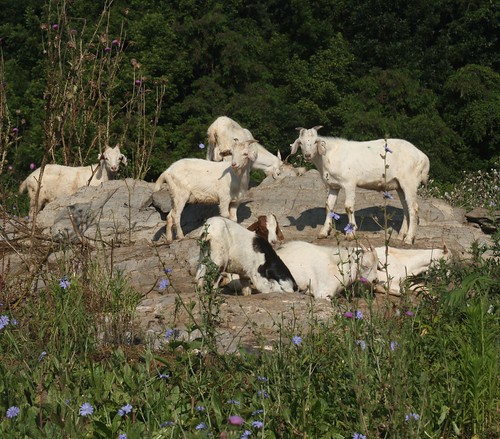
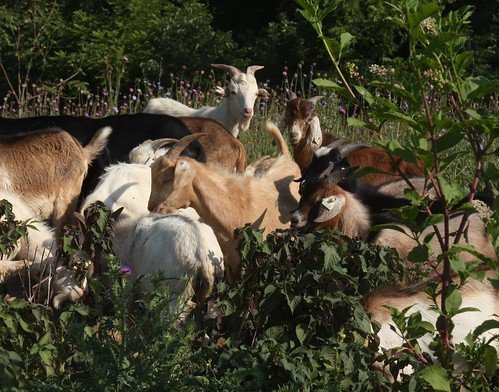
 Despite limited rainfall in the past month, internal parasites (worms) are starting to become more of an issue. FAMACHA© scores ranged from 1 to 4 and averaged 2.1, compared to 1.7 on July 1. Five goats required anthelmintic treatment and were administered Cydectin® 1% injectable at a dose of 1 ml per 110 lbs. Body condition scores declined slightly. Coat condition scores did not differ.