Thursday, June 17, 2010

Test officially begins

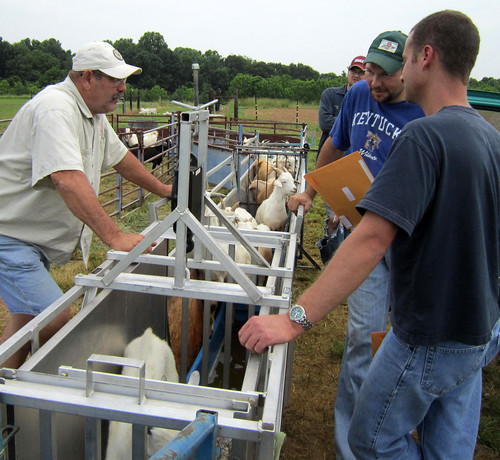
7 a.m. -- The goats were worked today by Jeff Semler, David Gordon, Jeanne Dietz-Band, and Susan Schoenian.  Data were recorded by Pam Thomas.

The first 12 days of the test served as an adjustment period. Official weights were determined by Jeff Semler. Starting weights ranged from 33 to 74 lbs. (15 to 34 kg) and averaged 46.2 lbs. (21 kg).  During the adjustment period, the goats gained an average of 1.7 lbs or 0.14 lbs. (64 g) per day. 

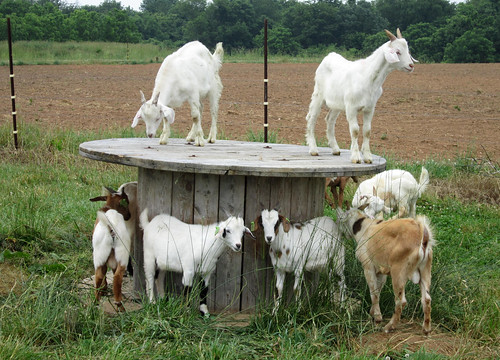
Kiko buck
Weight gain (or loss) varied considerably among the 72 goats and ranged from -10 to +11 lbs.  In general, the goats which were transported a farther distance seemed to put on more compensatory gain. 

FAMACHA© (eye anemia), body condition, coat condition, and dag scores were determined by Susan Schoenian.  Individual fecal samples were collected from each goat and mailed to Delaware State University for fecal egg count determination.  FAMACHA© scores ranged from 1 to 5 and averaged 1.7, compared to 1.6 on June 4-5.  

Seven goats required anthelmintic treatment.  This was unexpected and attributed to treatment failure, as the goats were treated with both albendazole and moxidectin upon arrival on June 4-5.  Treatment failure can be the result of anthelmintic (drug) resistance and/or improper administration of the drug(s). 

Goats with FAMACHA© scores of 4 or 5 (and some 3s) were dewormed again with moxidectin and/or levamisole and put in the treatment pen  for several days of observation.  While in the treatment pen, they are fed hay and fresh grass.

Body condition scores (1-5) ranged from 2 to 3.5 and averaged 2.7. While average body condition scores do not change much during the test, individual goats that become parasitized, sick for other reasons, or fail to adjust or perform on a pasture diet can be expected to lose body condition.  Coat condition scores (1-3) ranged from 1.5 to 3 and averaged 2.2.  The low scores were usually a result of lice infestation.
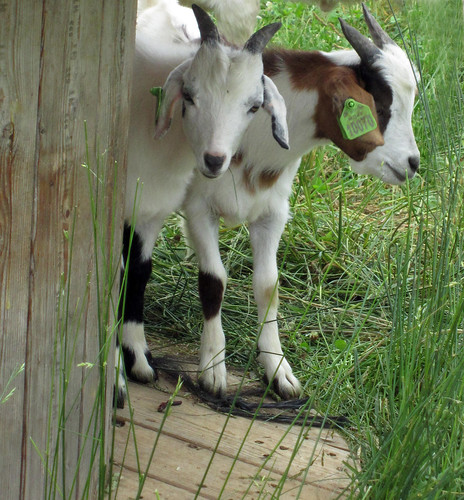
Myotonic bucks
For the first time, dag scores were recorded.  Dag scores estimate the build-up of fecal material on the hindquarters of an animal.  They are a measure of scouring which can be a symptom of non-barber pole worm infections.  Scours can also be caused by diet and stress.

A scale of 1 to 5 is used to denote dagginess, with 1 being free from fecal soiling and 5 being very soiled. Dag scores ranged from 1 to 4 and averaged 1.3.  More than 75 percent of the goats showed no evidence of scouring or fecal soiling.  Dag scores are a component of South Africa's new Five Point Check© for targeted selected treatment for internal parasites in small ruminants.

After today's working, the goats were given access to a two-acre paddock of cool season grasses.  They will be worked next on Thursday, July 1.

Download June 17 (d-0) report

Tuesday, June 8, 2010

72 goats start 2010 test

Seventy-two (72) goats started the 2010 Western Maryland Pasture-Based Meat Goat Performance Test. They were delivered to the test site on June 3, 4, and 5.  Goats were checked in by Susan Schoenian, Jeff Semler, and E. Nelson Escobar.  Special thanks is extended to the consigners who helped work the goats on Friday and Saturday.

This year's test group includes bucks from 20 herds and 12 states. Kentucky has the most consignments:  3 consigners and 13 goats.  Pennsylvania and Virginia each have 3 consigners and 10 goats.  The home state (Maryland) has two consigners and 8 goats.This is the first year that the test includes goats from North Carolina.  There are two new consigners from North Carolina.

Consigners (L-R): John Smith, Kendell Barnes, and Jarred Dennison

Upon arrival to the test site, the goats stood in a foot bath of zinc sulfate.  The purpose of foot bathing is to prevent hoof problems (e.g. foot rot or scald).  After standing in the foot bath, the goats were weighed by Jeff Semler.  They ranged in weight from 28 to 75 lbs. (12.7 to 34.1 kg) and averaged 44.3 lbs. (20.1 kg)  In last year's test, the goats were slightly heavier at 46.9 lbs. (21.3 kg).

As of the start of the test, the goats range in age from 77 to 171 days.  Their average age is 118 days or about 4 months. Most of the goats are Kiko or percentage Kiko. In addition, there are two Savanna, two Boer, and three Myotonic goats on test. There are numerous crossbreds containing varying mixtures of Kiko, Boer, Savanna, Spanish, and Nubian. Twenty-five (25) percent of the goats were creep-fed prior to their arrival at the test site.

After weighing, the goats were held on a work platform for close inspection.  FAMACHA© eye anemia, body condition, and coat condition scores were determined by Susan Schoenian. FAMACHA© scores ranged from 1 to 5 and averaged 1.6.  FAMACHA© scores are assessed to determine the need for anthelmintic treatment.  They are an indication of parasite resilience (or tolerance).

Bucks average 44.3 lbs.

Body condition and coat condition scores are indicators of general health and vigor.  They will used in combination with FAMACHA© scores and other factors to determine the need for future anthlemintic treatments. Body condition scores (1-5) ranged from 2 to 3.5 and averaged 2.7.  Coat condition scores (1-3) ranged from 1.5 to 3 and averaged 2.2.

All of the goats were dewormed with albendazole (Valbazen® drench) at 2x the labeled dose and moxidectin (Cydectin® 1% injectable) at the labeled dose.  The purpose of the double-deworming with anthelmintics from two different chemical classes is to reduce fecal egg counts to zero (or near-zero), so that the goats start the test equal and free from infection.

Individual fecal egg counts were collected from the rectum of each goat.  These samples will be sent to Dr. Dahlia O'Brien's lab at Delaware State University to determine individual fecal egg counts.  Fecal egg counts (FECs) are indicative of parasite resistance. It's good when a goat doesn't require deworming, but it's equally important that the goat doesn't shed a lot of worm eggs that will infect the pasture and cause problems for the more susceptible animals in the herd.

Average age of bucks is 118 days

A pooled fecal sample was collected from goats from each consigner. This sample will be sent to Dr. Ray Kaplan's lab at the University of Georgia College of Veterinary Medicine for fecal coproculture or larvae ID.  The eggs will be hatched and the parasite species will be determined by evaluating the larvae.  Stomach worm (strongyle) eggs look the same under a microscope and must be hatched for accurate identification. In previous years of the test, the barber pole worm (Haemonchus contortus) has accounted for the vast majority of worm infection.

For the first five days of the test, the goats will be treated for coccidiosis.  They will always have free choice access to goat minerals containing a coccidiostat.  Minerals for the 2010 test are being provided by Sweetlix®.

The first 12 days of the test will serve as an adjustment period. The official starting weights will be recorded on Thursday, June 17.   The goats are currently grazing a two acre paddock containing orchardgrass (1 acre) and volunteer weeds (1 acre).  The weather at the start of the test has been pleasant, not overly hot.