 One of the goals of the Western Maryland Pasture-Based Meat Goat Performance Test is to evaluate and compare carcass characteristics of meat goats consuming a pasture-only diet. This year, nine bucks were selected for harvest.
The bucks were transported from the test site to LambCo LLC for humane harvest on October 15. They were weighed immediately before harvest. Live weight (LW) ranged from 62 to 86 pounds and averaged 72 lbs. (37.7 kg).
Hot carcass weights (HCW) were determined soon after harvest and were used to calculate dressing percentages. For the nine goats, dressing percentage ranged from 38.8 percent to 49.2 percent and averaged 43.1 percent. Cold carcass weights (CCW) were used for other calculations.
Kidney and heart fat (KH) was removed from each carcass and weighed. While goats are known for depositing more internal fat than other livestock species, these goats had very minimal internal fat, less than 1% KH fat.
Rib eye area (REA) was measured between the 12th and 13th rib using a grid. Rib eye measurements ranged from 1.45 to 2.20 square inches and averaged 1.79 square inches. Actual measurements were about 0.5 square inches larger than the September 10th ultrasound measurements.
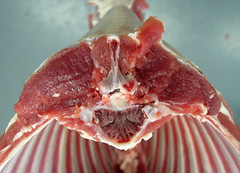 Back fat (BF) was very minimal (less than 0.05 inches) and could not be differentiated between carcasses. Body wall thickness (BWT) ranged from 0.30 to 0.55 inches and averaged 0.40 inches.
The carcasses were completely deboned. Fat and lean were separated from the bones, resulting in separate “piles” of bones, fat, and lean, which were weighed to determine carcass percentages.
The buck with the highest percentage of lean (carcass and live weight basis) was a purebred Kiko consigned by Craig Adams from Litchfield, Illinois. The other goat with outstanding carcass data was a 3/4 Kiko x 1/4 Spanish buck consigned by Wes Pinneo from Kincaid, Kansas.
Next year, we would like to harvest more goats from the test and perhaps incorporate a carcass contest into the performance testing program.
Download PDF file of data
Read full article and view data -- PDF


 On September 26, fecal egg counts ranged from 0 to 5680 and averaged 1584 epg. On September 10, the barber pole worm comprised 98% of the worm infection.
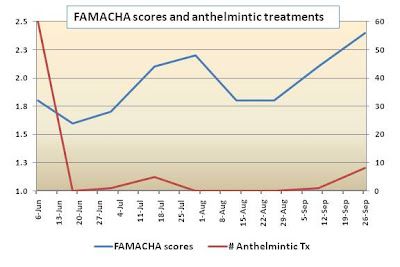 Parasite resistance was determined by fecal egg count data. Every two weeks a fecal sample was collected from the rectum of each goat. The samples were bagged, labeled, and stored on ice before being shipped overnite to Dr. Dahlia Jackson's parasitology lab at Delaware State University. Individual fecal egg counts were determined by the Modified McMaster procedure.
 The pooled sample was not cooled. It was sent via overnite mail in a vacuum-sealed bag to the University of Georgia. Fecal coproculture (larvae ID) was done by Dr. Ray Kaplan's lab in the College of Veterinary Medicine. In addition to identifying parasite larvae, a pooled fecal egg count was determined.